
Home -> Law Blog Directory -> Academic Blogs -> Essentially Contested America
(866) 635-2689 for Personal Injury or (866) 635-9402 for Criminal Defense
Find a Local Lawyer
Divorce (866) 635-6190
Personal Injury (866) 635-2689
Criminal Defense (866) 635-9402

Academic
: Essentially Contested AmericaA Republic or a Democracy? The Revolution of 1800 and the Foundations of American Democracy
By Robert Justin Lipkin
 consists
of the good and the bad. The good finds itself in republican democracy,
the only political organization that respects the inherent value of all
members of the polity. Some mistakenly believe that self-government is
grounded in skepticism about ethics and politics. Since no one can
demonstrate that her favorite system of government is absolutely true,
or so the argument goes, the natural conclusion is to vote on it.
Presto, the idea of "voting on it" itself becomes an attractive
paradigm for governing, not because we don't have any better idea, but
rather because self-government is a
substantive moral commitment to human dignity. The bad side of
self-government occurs when the electorate hands America's power over
to morally obtuse leaders who seek to impose self-government on the
rest of the world through the barrel of a gun and abandon domestic
constitutional values in the process.
That said, few Americans
are aware that the Founding constitutional philosophy--Federalism--was
not exactly consonant with republican democracy. John Adams once
expressed this disdain for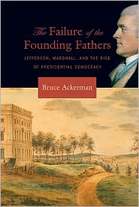 republican
democracy in a letter to Thomas Jefferson. "Elections, my dear sir,
Elections to offices which are great objects of Ambition, I look at
with terror." Adams was not alone in recoiling from democracy. The
Federalist Fisher Ames regarded republicanism--good self-government--to
be more different "from a democracy [bad self-government] than a
democracy [is] from . . . despotism." The Federalist Party was never
enamored with the idea of the people participating daily in the affairs
of self-government, nor would they have reveled in the notion that here
the people rule. More accurately, the Federalist imperative was "here
the elite(s) aka the Federalists) rule. It is worrisomely likely that
Federalists would never have appreciated why a government of the
people, by the people, and for the people should not perish from this
earth.
In the presidential election of 1800, the people
expressed their constitutional revulsion towards Federalist who
arguably betrayed the noble aspirations of the Revolutionary War by
kicking them out of office. However, due to a fault in the original
constitutional design, the presidential candidate of the winning Party,
the Democratic-Republicans, Thomas Jefferson and his  vice-presidential
candidate, Aaron Burr garnered the same number of presidential votes in
the Electoral College. Accordingly, it became the responsibility of the
Federalist controlled Congress to break the tie and select a president.
However, this presented the Federalists with a seemingly intractable
problem. Though Federalists reviled Jefferson, they ultimately chose
him over Burr because they believed burr to be unprincipled. Indeed,
Alexander Hamilton, a committed foe of Jefferson, was an instrumental force
behind this selection. Ironically, the man Hamilton prevented from
becoming president (and probably Governor of New York state in a later
election) would a few years later kill Hamilton in a dual.
While most Americans--even highly educated Americans--are unaware of the historical significance of the 1800 presidential election, historians, political scientists, and legal scholars specializing in constitutional evolution appreciate the election's pivotal importance. The election replaced the Federalists--advocating political elites or top-down governance--with Democratic-Republicans--advocating, at least in theory, power to the people. The crisis could have sunk the American experiment in self-government and devolved into civil war. But instead, it represents the birth of American democracy.
Three interesting books describe the significance of the election of 1800: Bruce Ackerman, The Failure of the Founding Fathers: Jefferson, Marshall, and the Rise of Presidential Democracy, Susan Dunn, Jefferson's Second Revolution: The election Crisis of 1800 and the Triumph of Republicanism (2004), and John Ferling, Adams v. Jefferson: The Tumultuous Election of 1800 (2004). Ackerman's book is intriguing for, among other reasons, his captivating speculation of how the crisis might have resulted in Secretary of State John Marshall, and soon-to-be Chief Justice john Marshall becoming president. Susan Dunn's grace and elegance in narrating the story makes it difficult to put down. John Ferling's depiction of the political rivalry between tow founding titans--Adams and Jefferson--compliments the two previous accounts.
These narratives raise an abstract, perhaps even an impenetrable question: If the American people, early in the Republic's history, switch from the founding
philosophy of elite governance to a new philosophy of empowering the
people without formally changing the Constitution through Article V,
why shouldn't we acknowledge this switch as a fundamental change in
constitutional philosophy and therefore in constitutional
interpretation. The electorate in 1800, some of whom signed the
Declaration of Independence and crafted the Constitution, rejected
Federalism's founding constitutional philosophy and chose a new one.
True, the process did not formally amend the Constitution, but the
change was certainly the functional equivalence of such s formal
amendment. In any event, the above titles provide riveting accounts of
one of the most significant elections in American history and should be
widely read by anyone committed to the dynamic ideals of American
constitutionalism.
One often hears bandied about that the Constitution created a republic not a democracy as if today the distinction has any currency. Few contemporary democrats, if any, advocate an absolutely majoritarian democracy with no constraints on the majority. Even fewer still believe that the electorate must vote on all legislation before it can become law. So the next time some genius says the Constitution set up a republic, not a democracy--as a reply to a criticism of American government for short-changing democracy--ask whether he knows the difference between these two political concepts and how these differences relate to contemporary American government. Better yet, ask if he ever heard of the presidential election of 1800 and the seismic revolution in the founding philosophy that this election initiated.
Full post as published by Essentially Contested America on April 02, 2008 (boomark / email).
American Airlines Settles Price Fixing Class Action
American Airlines Settles Price Fixing Class Action
American Corrective Counseling Services to Pay $2.55 Million In Pennsylvania Class Action
American Corrective Counseling Services to Pay $2.55 Million In Pennsylvania Class Action
First American Corporation
NYSE: FAF
American International Group, Inc.
AIG
First American Corporation
401k / ERISA Stock Fraud
American International Group, Inc.
401(k) / ERISA Stock Fraud

#1 Online Legal Resource

On 08-25 at 15:46PM
Acute perpendicular parking #NYPD #NYFD
On 08-18 at 22:18PM
Parallel parking gone bad. Too much gas UES NYC
On 08-18 at 21:41PM
UES NYC
On 08-18 at 21:25PM
Twitter suspends journalist critical of broadcast partner's coverage on dubious grounds @guyadams #nbcfail #twitterfail
On 07-30 at 17:57PM
Model example of 1st Amendment suppression by the People of New York City's Michael Bloomberg #OWS #NYPD
On 07-12 at 21:07PM
AG Holder lackadaisical on Operation in our Sites domain name seizures & RIAA lobbied free speech suppression @dajaz1
On 06-08 at 22:44PM
Why is the Catholic Church going to court over Obama contraception policy? @NewYorker commentary
On 05-31 at 10:08AM
Monks sue Louisiana for right to sell caskets made from forrest destroyed by Katrina
On 05-31 at 07:47AM
Are the abortion ultrasound laws headed for the Supreme Court?
On 05-15 at 21:52PM





Fourth of July Reading: Is It Time to Reboot Democracy
Democracy: No Guarantee of Freedom
Ruthann Robson on Sexual Democracy
Confucianism as China State Ideology
Book Announcement: Democracy Incorporated by Wolin





 |
|
Contact Us | About Us | Celebrity Law Blog |
Our Partners | Disclaimer
| Law Blog Directory
| Law Jobs
| Law Tweets
| Oil Spill Video
All original material © 1999-2011 by USLaw.com. All other material, including Blog Directory feed content, are © by their respective copyright holders. |