
Home -> Law Blog Directory -> Academic Blogs -> Essentially Contested America
(866) 635-2689 for Personal Injury or (866) 635-9402 for Criminal Defense
Find a Local Lawyer
Divorce (866) 635-6190
Personal Injury (866) 635-2689
Criminal Defense (866) 635-9402

Academic
: Essentially Contested AmericaIn Defense of "Fast Eddie Obama" and Shame on David Brooks
By Robert Justin Lipkin
Dr. Barack could have changed
the way presidential campaigning works. John McCain offered to have a series of
extended town-hall meetings around the country. But favored candidates don't go
in for unscripted free-range conversations. Fast Eddie Obama threw the
new-politics mantra under the truck.
And then on Thursday, Fast
Eddie Obama had his finest hour. Barack Obama has worked on political reform
more than any other issue. He aspires to be to political reform what Bono is to
fighting disease in Africa. He's spent much of his career talking about how
much he believes in public financing. In January 2007, he told Larry King that
the public-financing system works. In February 2007, he challenged Republicans
to limit their spending and vowed to do so along with them if he were the
nominee. In February 2008, he said he would aggressively pursue spending
limits. He answered a Midwest Democracy Network questionnaire by reminding
everyone that he has been a longtime advocate of the public-financing system.
But Thursday, at the first
breath of political inconvenience, Fast Eddie Obama threw public financing
under the truck. In so doing, he probably dealt a death-blow to the cause of
campaign-finance reform. And the only thing that changed between Thursday and
when he lauded the system is that Obama's got more money now.
And Fast Eddie Obama didn't
just sell out the primary cause of his life. He did it with style. He did it
with a video so risibly insincere that somewhere down in the shadow world, Lee
Atwater is gaping and applauding. Obama blamed the (so far marginal) Republican
527s. He claimed that private donations are really public financing. He made a
cut-throat political calculation seem like Mother Teresa's final steps to sainthood.
Breaking a promise? Yes. Unjustified? More complicated. But here I just want to mention a few of the many things wrong with Brook's piece. First, the term "split-personality" refers to a schizophrenic condition in
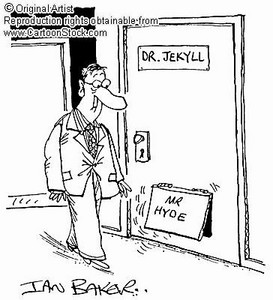 which
there is a split in the patient's (single personality) between thought
and feelings. The term Brooks should have used was "multiple
personality," the condition that Dr. Jekyll suffered from. A totally
different personality Mr. Hyde emerged at conspicuous times from Dr.
Jekyll and the good doctor was for the was part unaware of this
occurrence. Two personalities existed in this case and neither was
split. This is not simply a pedantic quarrel. Brooks is a dilettante.
He knows a little about a lot of subjects, but he lacks a depth of
knowledge about any. He knows, for example, that there's a psychiatric
condition called "split personality" but he doesn't take the time to
explore its relationship to multiple personality disorder which is
clearly what he had in mind.
However, my central objection to Brooks piece is this: His position calls for
campaign perfectionalism. Never break a promise. Never veer from you articulated course. No matter what. Stick to your "principles" no matter what the consequences. Why even if you start a war which was ill-conceived, and a "foreign policy blunder" stick it out! Stay the course! Just who is an exemplar of Mr. Brook's' conception of competent and morally grounded presidential leadership.Tactical decisions must be made daily in campaigning for president. Without the ability to make some unappealing, yes, even morally wrong, decisions, a political reformer is simply a Utopian who perhaps has wonderfully
idealistic strategic goals, but is too quixotic to ever win an election. It's convenient--perhaps too convenient--for a self-avowed conservative, like Mr. Brooks, to urge Obama to retain his ethical perfectionist virtues and lose the election as a result. Moreover, no one is qualified to be president without being ready to make some morally ugly choices. Such an individual would be unable to run the nation's domestic affairs nor defend the nation from foreign predators. This doesn't mean that such an individual simply sells out. There is a quantitative dimension here. How often is the imperfect reformer inclined to break his word. Most of the examples Brooks uses can be interpreted in a plausible non-hypocritical fashion. Regarding Rev. Wright, Obama simply had too much. Who knows Obama--any reasonable person--might have denounced his grandmother if she acted in a similar manner.And consider that Obama's choice to opt out of public funding for his campaign may have just won him the election. Is that the reason Republicans like Lindsay Graham and Brooks are so offended. Does Brooks prefer a reformer who stays completely true to his principles and loses or one who sometimes retreats and wins. What if the individual were a Republican candidate? The more one thinks about Brooks' piece the more won wonders about ulterior motives.
Anyone who believes that a self-avowed reformer will never act contrary to reform principles is living in a hermitage. Moreover, there are times
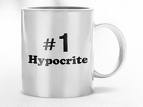 when even reformers should
make such choices. The question for American citizens is not whether
Obama betrayed one of his "core principles," but rather whether he is
inclined to make a habit of it as do other politicians. If the
reformers principles generally are attractive and if he or she
generally stands by those principles, the reformer is still better than
an ordinary politician with non-reformer goals. Let's be grateful for
Fast Eddie Obama unless he emerges too often. Wait! Perhaps that's
Brooks' point. Let's stop Obama from betraying his principles because
then the next Democratic reformer might act for the most part on his
reform principles and reform is not what we Republicans want. Who is
the greater hypocrite here? Obama or Brooks?
Credit for First Image
Credit for Second Image
Full post as published by Essentially Contested America on June 23, 2008 (boomark / email).
Self Defense
It's legal to defend yourself and your family
Is Obama a Natural Born Citien?
Philip J. Berg, Esquire vs. Barack Hussein Obama, a/k/a Barry Soetoro, a/k/a Barry Obama, a/k/a Barack Dunham, a/k/a Barry Dunham, et al
Slim-Fast Recalled in US
Slim-Fast recalled in US
David Hasselhoff Divorce
Baywatch star reaches settlement in family lawsuit.
Brooks
Class Action Settlement
CIA
Department of Defense Sued by Veterans
Ministry of Defense
$500,000 in damages in transgender humiliation suit.
The Ministry of Defense
$500,000 in damages in transgender humiliation suit.

#1 Online Legal Resource

On 08-25 at 15:46PM
Acute perpendicular parking #NYPD #NYFD
On 08-18 at 22:18PM
Parallel parking gone bad. Too much gas UES NYC
On 08-18 at 21:41PM
UES NYC
On 08-18 at 21:25PM
Twitter suspends journalist critical of broadcast partner's coverage on dubious grounds @guyadams #nbcfail #twitterfail
On 07-30 at 17:57PM
Model example of 1st Amendment suppression by the People of New York City's Michael Bloomberg #OWS #NYPD
On 07-12 at 21:07PM
AG Holder lackadaisical on Operation in our Sites domain name seizures & RIAA lobbied free speech suppression @dajaz1
On 06-08 at 22:44PM
Why is the Catholic Church going to court over Obama contraception policy? @NewYorker commentary
On 05-31 at 10:08AM
Monks sue Louisiana for right to sell caskets made from forrest destroyed by Katrina
On 05-31 at 07:47AM
Are the abortion ultrasound laws headed for the Supreme Court?
On 05-15 at 21:52PM







Obama picks Veep nominee whose main claim to fame is being caught repeatedly as a plagiarist
Obama, McCain, and the Farm Bill
David Brooks, Dictatorship of Talent (China - USA)
David Brooks: Behavioral Genetics not so promising





 |
|
Contact Us | About Us | Celebrity Law Blog |
Our Partners | Disclaimer
| Law Blog Directory
| Law Jobs
| Law Tweets
| Oil Spill Video
All original material © 1999-2011 by USLaw.com. All other material, including Blog Directory feed content, are © by their respective copyright holders. |