
Home -> Law Blog Directory -> Academic Blogs -> Essentially Contested America
(866) 635-2689 for Personal Injury or (866) 635-9402 for Criminal Defense
Find a Local Lawyer
Divorce (866) 635-6190
Personal Injury (866) 635-2689
Criminal Defense (866) 635-9402

Academic
: Essentially Contested AmericaDo Democrats Really Want a Plural Presidency?
By Robert Justin Lipkin

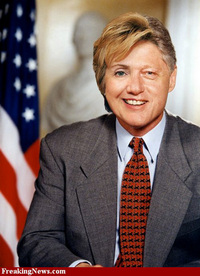 media (the content of which is sometimes on target), provides a window into what life will be like under President Hillary Clinton and First Gentleman Bill. It's not a pretty picture. This is not to say that Mr. Clinton's remarks are all preposterous or absurd. Rather, are we prepared to listen to him in attack-and-defend mode for another four to eight years? Democrats should now ponder Gary Wills' critically important question, "Does anyone expect him [Bill Clinton] not to use his experience in an energetic way if he re-enters the White House as the first spouse?" Democrats should reflect on this question and Mr. Wills' answer: "This is not a new question. It was intensely debated in the convention that formulated our Constitution. The Virginia Plan for the new document submitted by Edmund Randolph and the New Jersey Plan submitted by William Paterson left open the number of officers to hold the executive power. . . . Some (like Hugh Williamson of North Carolina) argued for a three-person executive, each member coming from a different region of the country. More people argued (like George Mason of Virginia) for a multiple-member executive council.
According to Mr. Wills, "[t]he objection to giving executive power to a single person came from the framers' experience with the British monarchy and the royal governors of the colonies. They did not want another monarch. . . . But as the debate went forward a consensus formed that republican rule would check the single initiative of a president. In fact, accountability to the legislature demanded that responsibility be lodged where it could be called to account. A plural presidency would leave it uncertain whom to check. How, for instance, would Congress decide which part of the executive should be impeached in case of high crimes and misdemeanors? One member of the plural executive could hide behind the other members."
It was the problem of accountability that drove "James Wilson of Pennsylvania[to make] . . . the argument for a single officeholder with typical depth and precision: "To control the executive, you must unite it. One man will be more responsible than three. Three will contend among themselves till one becomes the master of his colleagues. In the triumvirates of Rome, first Caesar, then Augustus, are witnesses of this truth. The kings of Sparta and the consuls of Rome prove also the factious consequences of dividing the executive magistracy." . . . Wilson and his allies carried the day; and their argument is as good now as when they embedded it in the Constitution."
Wills drives his point home by referring to our excruciating experience of the past seven years. "One problem with the George W. Bush administration is that it has brought a kind of plural presidency in through the back door. Vice President Dick Cheney has run his own executive department, with its own intelligence and military operations, not open to scrutiny, as he
 hides behind the putative president. . . . No other vice president in our history has taken on so many presidential prerogatives, with so few checks. He is an example of the very thing James Wilson was trying to prevent by having one locus of authority in the executive. The attempt to escape single responsibility was perfectly exemplified when his counsel argued that Mr. Cheney was not subject to executive rules because he was also part of the legislature. . . . We have seen in this campaign how former President Clinton rushes to the defense of presidential candidate Clinton. Will that pattern of protection be continued into the new presidency, with not only his defending her but also her defending whatever he might do in his energetic way while she's in office? It seems likely. And at a time when we should be trying to return to the single-executive system the Constitution prescribes, it does not seem to be a good idea to put another co-president in the White House."
Democrats have ample reason to recoil from the prospect of a co-presidency of Clintons. The problem, of course, just what is the alternative. Mr. Obama is capable, honest, and refreshing. But his theme of hope, unity, and change has been tried and failed before. How can we successfully reach out to our opponents in a polarized world that promises to stay polarized despite Mr. Obama's best efforts? In such a world, John Edwards' tenacity and intelligence is attractive, but his chances of winning the nomination are worse than remote. Democrats are faced with painful choice. Wisely or not, some Democrats will stay at home if the choice is between John McCain and the Clintons.
Credit for First Image
Credit For Second Image
Full post as published by Essentially Contested America on January 27, 2008 (boomark / email).

#1 Online Legal Resource

On 08-25 at 15:46PM
Acute perpendicular parking #NYPD #NYFD
On 08-18 at 22:18PM
Parallel parking gone bad. Too much gas UES NYC
On 08-18 at 21:41PM
UES NYC
On 08-18 at 21:25PM
Twitter suspends journalist critical of broadcast partner's coverage on dubious grounds @guyadams #nbcfail #twitterfail
On 07-30 at 17:57PM
Model example of 1st Amendment suppression by the People of New York City's Michael Bloomberg #OWS #NYPD
On 07-12 at 21:07PM
AG Holder lackadaisical on Operation in our Sites domain name seizures & RIAA lobbied free speech suppression @dajaz1
On 06-08 at 22:44PM
Why is the Catholic Church going to court over Obama contraception policy? @NewYorker commentary
On 05-31 at 10:08AM
Monks sue Louisiana for right to sell caskets made from forrest destroyed by Katrina
On 05-31 at 07:47AM
Are the abortion ultrasound laws headed for the Supreme Court?
On 05-15 at 21:52PM







The Vicissitudes of the Latin Plural in English
Grammar Guide: A rule on forming plurals
Can Obama Win Without Clinton Democrats
Conference: Plural Jurisdictions and Islamic Law





 |
|
Contact Us | About Us | Celebrity Law Blog |
Our Partners | Disclaimer
| Law Blog Directory
| Law Jobs
| Law Tweets
| Oil Spill Video
All original material © 1999-2011 by USLaw.com. All other material, including Blog Directory feed content, are © by their respective copyright holders. |