
Home -> Law Blog Directory -> Patent Law Blogs -> IP ADR Blog
(866) 635-2689 for Personal Injury or (866) 635-9402 for Criminal Defense
Find a Local Lawyer
Divorce (866) 635-6190
Personal Injury (866) 635-2689
Criminal Defense (866) 635-9402

Patent Law
: IP ADR BlogBlawg Review #189 at Infamy or Praise Delivers the Goods
By Les Weinstein, Michael Young, John Leo Wagner, Eric van Ginkel, and Victoria Pynchon

Remember those days - largely before you went to law school - when you believed all lawyers with whom you were going to practice would evidence the benefits of a classical education? I believed. As did two ex-husbands until they first attended law firm holiday parties. No mariner ever pulled them away from the hors d'oeuvres table to arrest them with the power of a seafaring tale.
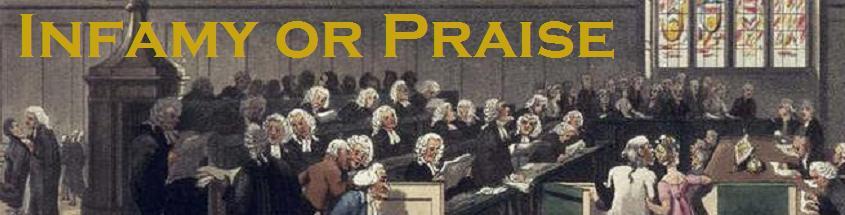
Alas, we divorced years and years before I could give them Blawg Review #189 as Exhibit A to restore their pre-law belief in the well-educated and sophisticated legal practitioner. In #189, Colin Samuels restores the image of the legal profession by following the tale of the Ancient Mariner -- he of the "long grey beard and glittering eye" -- who weaves an irresistible narrative for the transfixed wedding guest, a story seared into the memories of those of us who happily squandered our University years studying literature. ("what are you going to do with a literature degree, honey?")
Audaciously comparing those of us who blog to the mighty Coleridge, Colin Samuels writes:
As writers, many of us have struggled to find our voices online. Do we write as we would speak to friends and colleagues or as we would write for professional publication? Do we censor ourselves or seek controversy? Do we write on non-legal topics or maintain a strictly professional image online? Will our writing be an end in itself or a means to another end? Each new legal blogger has asked these and many other questions of himself or herself, only to find them being asked again and again as his or her blogging continues. As highly-educated professionals, we are often the severest and most persistent critics of our own writing.
Like the Mariner, Samuels' most recent Blawg Review (see his previous brilliant efforts based upon Dante's Hell, Purgatory, and Heaven) so arrested my attention that I didn't even do what I must admit I always do with Blawg Review -- skim down to see whether one of my weekly posts was included (not).
I can only say to you: Read it. Now. And if you're looking to justify your IP time, here are the IP links you will find woven into one of the great narrative poems of English Literature.
Venkat Balasubramani wrote that the government's use of the Computer Fraud and Abuse Act has led to a muddled discussion which confuses two separate issues: "Somehow the discussion has shifted from whether it's appropriate to use Ms. Drew's commission of a tort to support a CFAA conviction to whether the CFAA should cover access in excess of a website's terms of use. Two conceptually distinct issues that people tend to conflate."
The Media Bloggers Association legal blog explained the import of the verdict for bloggers: "There is understandable concern among many online commentators about the implications of the particular legal theories that formed the basis of the convictions, based fundamentally on the violation of various levels of online terms of service that are seldom more than glanced at and clicked through by experienced Internet users. The MBA encourages responsible use of the online resources via its Statement of Principles...."Shortly after the verdict, Orin Kerr posted a tongue-in-cheek revised Terms of Service for The Volokh Conspiracy blog. These revised terms, which required such user promises as "Your middle name is not 'Ralph'," "You're super nice," and "You have never visited Alaska," were meant to illustrate how easily (and routinely) we can violate the use terms of many sites, resulting in potential criminal liability after the Drew decision. Scott Greenfield commented that "As terms of service go, Orin's are relatively reasonable." Greenfield noted that his blog has only one rule ("No assholes"), but that he has and will apply it arbitrarily and ruthlessly.
Frank Pasquale considered whether Google, which has become a gatekeeper for much of the world's online information, should have the right to censor that information: "Bottom line: someone in government has to have the right to determine "if the search algorithm [has become] biased." Without that basic assurance, black box search engines now are about as big a menace as the black box economy was five years ago. We trust the math wizards at Google now as much as we used to admire the financial innovators at Bear Sterns and Goldman. Only time will tell if our faith in the mathematicians was misplaced yet again." Meanwhile, Google's weak sister, Yahoo!, has apparently thrown in the towel on its internet radio project, ceding the project to CBS. David Oxenford discussed whether the move would affect the decisions recently made by the Copyright Royalty Board, which relied at least in part on arguments about internet radio's economic power which have not been borne out.
Maya Richard suggested four tactics to preemptively protect patent assets from patent trolls: monitoring patent filings for applications related to your portfolio; hedging risk with patent infringement insurance; retaining skilled IP counsel to build a case for major patent assets; and joining an industry protection group. Also writing on a patent-related topic was R. David Donaghue, who noted that despite the Twombly decision, "many district courts are requiring that patent defendants plead affirmative defenses and, in some cases, counterclaims to the higher plausibility standard." He suggests remedies for this uneven application of the Twombly standards.
id you think road kill would be the most unlikely legal topic addressed in this Blawg Review? Hah! Ron Coleman explained that "tackiness is not grounds for refusal to register" a trademark. The owners of the Chippendale's male striptease concern are hoping to register their distinctive collar-and-cuffs costume as a trademark and Coleman pointed out that they've lined-up some considerable legal and expert support for their efforts. John Welch noted that the PTO has already "conceded that the Chippendale 'outfit' is product packaging rather than product shape" and Ryan Gile added that, faced with "400 pages of evidence [presented by Chippendale's, the] PTO had no problem recognizing that the Chippendales trade dress had acquired distinctiveness." Rebecca Tushnet suggested that the claims were limited in the application, but confused rather than clarified matters: "If the fact that the torso wearing the collar and bow tie is unclothed is not part of the mark, then any man in an outfit with cuffs and a bow tie is copying the Chippendale's mark."
Blawg Review sails on next week when Marc Randazza and his Satyriconistas at The Legal Satyricon host.
Blawg Review has information about next week's host and instructions how to get your blawg posts reviewed in upcoming issues.
Full post as published by IP ADR Blog on December 08, 2008 (boomark / email).
ValueClick
allegedly violated consumer protection laws by promising ‘free’ goods that where not actually free.
FDA Issues Update on Safety Review Orlistat
Orlistat FDA Issues Update on Safety Review
Aurora Loan Faces Class Action over Mortgage Review Services
Aurora Loan Faces Class Action over Mortgage Review Services
FDA Review of Prostate Cancer Treatment Prompts Warning of Risk for Diabetes
Prostate Cancer Treatment FDA Review Prompts Warning of Risk for Diabetes
Xigris
Study Prompts FDA Safety Review
Lipitor
Review of Studies Show No Significant Benefit in Women

#1 Online Legal Resource

On 08-25 at 15:46PM
Acute perpendicular parking #NYPD #NYFD
On 08-18 at 22:18PM
Parallel parking gone bad. Too much gas UES NYC
On 08-18 at 21:41PM
UES NYC
On 08-18 at 21:25PM
Twitter suspends journalist critical of broadcast partner's coverage on dubious grounds @guyadams #nbcfail #twitterfail
On 07-30 at 17:57PM
Model example of 1st Amendment suppression by the People of New York City's Michael Bloomberg #OWS #NYPD
On 07-12 at 21:07PM
AG Holder lackadaisical on Operation in our Sites domain name seizures & RIAA lobbied free speech suppression @dajaz1
On 06-08 at 22:44PM
Why is the Catholic Church going to court over Obama contraception policy? @NewYorker commentary
On 05-31 at 10:08AM
Monks sue Louisiana for right to sell caskets made from forrest destroyed by Katrina
On 05-31 at 07:47AM
Are the abortion ultrasound laws headed for the Supreme Court?
On 05-15 at 21:52PM





Blawg Review of the Ancient Mariner
Just Praise: For Colin Samuels and Blawg Review #189.
Blawg Review: Colin Samuels’s class act





 |
|
Contact Us | About Us | Celebrity Law Blog |
Our Partners | Disclaimer
| Law Blog Directory
| Law Jobs
| Law Tweets
| Oil Spill Video
All original material © 1999-2011 by USLaw.com. All other material, including Blog Directory feed content, are © by their respective copyright holders. |