
Home -> Law Blog Directory -> Academic Blogs -> Essentially Contested America
(866) 635-2689 for Personal Injury or (866) 635-9402 for Criminal Defense
Find a Local Lawyer
Divorce (866) 635-6190
Personal Injury (866) 635-2689
Criminal Defense (866) 635-9402

Academic
: Essentially Contested AmericaJust How Good Was 2007 in Iraq?
By Robert Justin Lipkin
 security
in Baghdad and the western al-Anbar province, the two most violent
areas. By June, an additional 28,000 troops had been deployed to Iraq,
bringing the total number up to more than 160,000. . . . By autumn, there were over 175,000 U.S. military personnel in Iraq.
This is the highest number of U.S. troops deployed yet, and while the
U.S. government continues to talk of withdrawing some, the numbers on
the ground appear to contradict these promises.
. . . The Bush administration said the 'surge' was also aimed at
curbing sectarian killings, and to gain time for political reform for
the government of U.S.-backed Prime Minister Nouri al-Maliki. . . . During the surge, the number of Iraqis displaced from their homes
quadrupled, according to the Iraqi Red Crescent. By the end of 2007,
the United Nations High Commissioner for Refugees (UNHCR) estimated
that there are over 2.3 million internally displaced persons within
Iraq, and over 2.3 million Iraqis who have fled the country.
. . . Iraq has a population around 25 million."
For the entire article click here. For a scathing criticism of both Republicans and Democrats for buying the administration's tripe about the success of the surge click here.
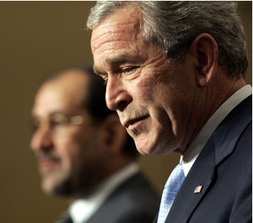
I think it's fair to say that the surge has been somewhat effective. But the real question is effective to do what. 2007 has seen the death of American soldiers in higher numbers than any year of the war. Although, violence is down in Baghdad, the city has become fractionated. Neighborhoods defined in religious and ethnic terms are barricaded preventing the free flow of people, news, and products necessary to any thriving metropolis. Sunni insurgents have turned on Al-Qaeda but still refuse to swear allegiance to the central government. The "central government"! That's a laugh. The Maliki regime has not come an inch closer to making the hard decisions about security, unifying the country, the problem of homelessness and refugees, and the appropriate distribution of oil revenues. Is that Mr. Maliki's fault? Well sure, in part. But before we castigate Mr. Maliki consider this: "
Blaming the prime minister of Iraq, rather than the president of the United States, for the spectacular failure of American policy, is cynical politics, pure and simple. It is neither fair nor helpful in figuring out how to end America's biggest foreign policy fiasco since Vietnam. That, of course, does not get Mr. Maliki off the hook. Indeed, "Prime Minister Nuri Kamal al-Maliki has been catastrophic for Iraq ever since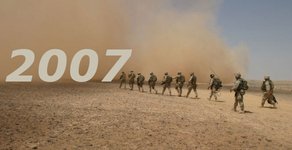 he took over from the equally disastrous
Ibrahim al-Jaafari more than a year ago." But Mr. Bush refuses to
acknowledge that Iraq is a failed nation-state. Hoping for authentic
democracy in Iraq is a pipe dream that only someone who insists that if
he believes and hopes for something strongly enough, it will come to
pass. The surge would have worked if it enabled Iraqi politicians to
create the semblance of a free and viable government. There's no
chance of that happening as long as the United States plays an active
role in Iraq.
Credit for First Image
Credit for Second Image
Full post as published by Essentially Contested America on January 12, 2008 (boomark / email).
Income Tax Changes for 2007
Get Answers to your Income Tax Questions
Lexus Inc. and Toyota Motor Sales Inc.
allegedly failed to correct problems with the front passenger air bag system in thousands of 2007 Lexus ES350 vehicles.

#1 Online Legal Resource

On 08-25 at 15:46PM
Acute perpendicular parking #NYPD #NYFD
On 08-18 at 22:18PM
Parallel parking gone bad. Too much gas UES NYC
On 08-18 at 21:41PM
UES NYC
On 08-18 at 21:25PM
Twitter suspends journalist critical of broadcast partner's coverage on dubious grounds @guyadams #nbcfail #twitterfail
On 07-30 at 17:57PM
Model example of 1st Amendment suppression by the People of New York City's Michael Bloomberg #OWS #NYPD
On 07-12 at 21:07PM
AG Holder lackadaisical on Operation in our Sites domain name seizures & RIAA lobbied free speech suppression @dajaz1
On 06-08 at 22:44PM
Why is the Catholic Church going to court over Obama contraception policy? @NewYorker commentary
On 05-31 at 10:08AM
Monks sue Louisiana for right to sell caskets made from forrest destroyed by Katrina
On 05-31 at 07:47AM
Are the abortion ultrasound laws headed for the Supreme Court?
On 05-15 at 21:52PM







Measuring Stability and Security in Iraq: Quarterly Report (December 2007)
Iraq Landmine Impact Survey - Final Report 2007
Leaving Iraq Without Leaving Iraq in Chaos
Cerebral Palsy and an adoption from Iraq
Petraeus Remarks on Lack of Progress in Iraq Prove Bushs Iraq Policy Has Failed
SIGIR: Anticorruption Efforts in Iraq: U.S. and Iraq Take Actions but Much Remains to be Done





 |
|
Contact Us | About Us | Celebrity Law Blog |
Our Partners | Disclaimer
| Law Blog Directory
| Law Jobs
| Law Tweets
| Oil Spill Video
All original material © 1999-2011 by USLaw.com. All other material, including Blog Directory feed content, are © by their respective copyright holders. |