
Home -> Law Blog Directory -> Intellectual Property Law Blogs -> IPKat
(866) 635-2689 for Personal Injury or (866) 635-9402 for Criminal Defense
Find a Local Lawyer
Divorce (866) 635-6190
Personal Injury (866) 635-2689
Criminal Defense (866) 635-9402

Intellectual Property Law
: IPKatFor the avoidance of accidents, or worse?
By Johanna Gibson, David Pearce, Jeremy Phillips and Ilanah Simon.

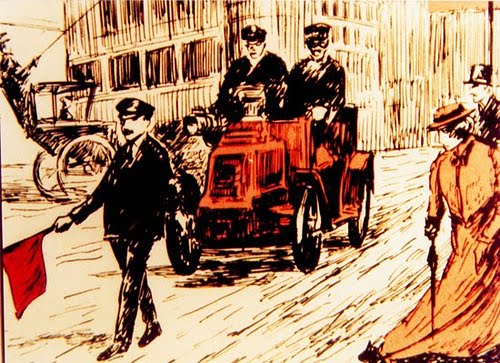
had to be led by a man who walked in front of the car,
carrying a red flag -- to prevent 'fatal accidents'
An interesting communication has come the IPKat's way. It seems to be about a rather delicate question -- do applicants for Community trade marks who are based outside the European Union really have to go to the trouble and expense of engaging a professional representative from within the EU? -- and it reads, in relevant part, like this:
"Proposed change of practice on professional representation... the Office [for Harmonisation in the Internal Market] has proposed changing the existing practice with regard to the mandatory appointment of a professional representative within the EU for all Community trade mark applications coming from undertakings based outside the EU. ...
The Office has carefully reviewed the issue and has concluded that professional representation within the EU is only legally required if there need to be certain legal exchanges with the applicant. For example if there is some kind of deficiency, an Absolute Ground or class objection, an opposition or third party observation.The IPKat has a funny feeling that "users' associations" doesn't mean "associations of people who use trade marks", but rather "people who get paid by clients to represent them in matters concerning Community trade marks" but, since he doesn't know whether this is so, he couldn't possibly say. Merpel is absolutely certain, though, that there must be some incredibly important reason why non-EU-based Community trade mark applicants must be forced to instruct an EU professional representative -- possibly to protect them from fatal accidents -- and that the suggestion of "self-interest" must never be allowed to enter our thoughts.The Office proposed, therefore, to remove the routine check on this question at the examination stage, and instead to only ask for an EU representative (if none is indicated) when a legal exchange is required. We believe this is in line with the legal requirements, fairer to the client, and more efficient from our point of view.
However, on sharing this point of view with user associations, we found there were strong objections from some of them. In order to allow these objections to be fully considered, we have decided not to introduce this change of practice. Instead, we will be asking the European Commission to consider the question as part of the ongoing review of the functioning of the trade mark system in Europe ...".

Full post as published by IPKat on August 13, 2010 (boomark / email).
Car Accidents
alleging liability for personal injuries caused by car, truck, bus, motorcycle or other vehicle accidents.
California Car Accidents
alleging liability for personal injuries caused by car, truck, bus, motorcycle or other vehicle accidents.
Missouri Accidents
alleging liability for personal injuries caused by car, truck, bus, motorcycle or other Missouri vehicle accidents.
Fire Accidents
alleging fire related accidents can lead to personal injury and property damage.
Kansas City Accidents
alleging liability for personal injuries caused by car, truck, bus, motorcycle or other Kansas City, Missouri vehicle accidents.
Bicycle Accidents
due to manufacturers defects or collisions with motor vehicles, etc.

#1 Online Legal Resource

On 08-25 at 15:46PM
Acute perpendicular parking #NYPD #NYFD
On 08-18 at 22:18PM
Parallel parking gone bad. Too much gas UES NYC
On 08-18 at 21:41PM
UES NYC
On 08-18 at 21:25PM
Twitter suspends journalist critical of broadcast partner's coverage on dubious grounds @guyadams #nbcfail #twitterfail
On 07-30 at 17:57PM
Model example of 1st Amendment suppression by the People of New York City's Michael Bloomberg #OWS #NYPD
On 07-12 at 21:07PM
AG Holder lackadaisical on Operation in our Sites domain name seizures & RIAA lobbied free speech suppression @dajaz1
On 06-08 at 22:44PM
Why is the Catholic Church going to court over Obama contraception policy? @NewYorker commentary
On 05-31 at 10:08AM
Monks sue Louisiana for right to sell caskets made from forrest destroyed by Katrina
On 05-31 at 07:47AM
Are the abortion ultrasound laws headed for the Supreme Court?
On 05-15 at 21:52PM





Constitutional Avoidance, Anti-Avoidance, NAMUDNO, and Citizens United
Hasen on Constitutional Avoidance
Prebble & Prebble: The Morality of Tax Avoidance
Clausing: Multinational Firm Tax Avoidance and Tax Policy
Faulhaber: Sovereignty, Integration, and Tax Avoidance in the European Union
Revised Version of My Paper on Constitutional Avoidance, Citizens United, and NAMUDNO Now Available





 |
|
Contact Us | About Us | Celebrity Law Blog |
Our Partners | Disclaimer
| Law Blog Directory
| Law Jobs
| Law Tweets
| Oil Spill Video
All original material © 1999-2011 by USLaw.com. All other material, including Blog Directory feed content, are © by their respective copyright holders. |