
Home -> Law Blog Directory -> Academic Blogs -> Essentially Contested America
(866) 635-2689 for Personal Injury or (866) 635-9402 for Criminal Defense
Find a Local Lawyer
Divorce (866) 635-6190
Personal Injury (866) 635-2689
Criminal Defense (866) 635-9402

Academic
: Essentially Contested AmericaSo You Think You're Smarter Than James Madison, Eh? Well Why Not?
By Robert Justin Lipkin

James Madison, the so-called "father of the Constitution" was a bright guy. So were all the founders bright guys: George Washington, John Adams, 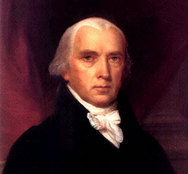 Thomas Jefferson, Ben Franklin, Alexander Hamilton, James Wilson, and so forth. The Constitution they composed was perhaps the best they could do at the time. I say "perhaps" because James Madison was appalled by the document that emerged from the Constitutional Convention. For Madison, the Constitution proposed gave too much power to the fractious, quarrelsome, and petty leaders of the states. But though woefully disappointed that the states retained too much power, Madison went on to become an effective spokesperson urging ratification. And it was the very same failure to strip the states of power at the Constitutional convention that became Madison's cudgel which he used to rout the anti-ratification forces by insisting that the Constitution preserved states' rights. Indeed, in the Virginia Constitutional Convention, where Madison and Patrick Henry were the key leaders of the pro- and anti-ratification forces respectively, Madison rebuffed Henry's complaint that the states were slighted in Philadelphia. In short, Madison's disappointment that the Constitution failed to create a strong central government was the very reason he urged Virginians to ratify the document.
In particular, Madison sought a congressional veto over state legislation but he lost this battle. Consider Gordon Wood's depiction of this incident.
Madison was . . . deeply disheartened and convinced that the Constitution was doomed to fail. Indeed, just before the convention adjourned, he told Jefferson that the new federal government would accomplish none of its goals. The Constitution, he said, 'will neither effectually answer the national object nor prevent the local mischiefs which every where excite disgusts against the state governments.' This extraordinary statement gives us some idea of how little the final Constitution resembled his original intentions. Gordon S. Wood, Revolutionary Characters: What Made the Founders Different 160 (2006).
Though demoralized, Madison did not lose hope that the new constitutional design would include an institution or practice--a council of revision, if you will--which would ultimately veto harmful state legislation. Accordingly, reverence for the founders--that their expertise about constitutional design is necessarily superior to ours--flies in the face of history.Keeping this in mind let me reiterate a proposal for regularizing constitutional change. Keep in mind Jefferson's pronouncement that
the earth is for the living not the dead, and recall his insouciant remark that a little rebellion now and then was a healthy feature of a republican democracy. For Jeffersonians--who virtually controlled the presidency from 1800 through the 1830s--the Revolution of 1800 changed the stewardship of the fledgling nation from the Federalists--the party of the Constitution--to the Jeffersonians--the party of the Declaration of Independence. If the nation could change so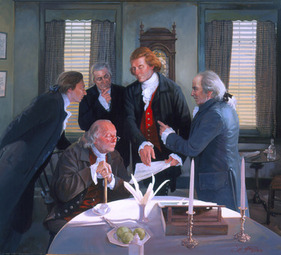 drastically then, what's wrong with regularizing constitutional change now? Accordingly, why not call a constitutional convention with one goal to vote up or down a proposal to regularize constitutional evolution. Let's say every twenty years, Americans will be asked to re-ratify the Constitution or its central Articles and provisions. Those Articles not receiving the necessary votes will be replaced with constitutional text acceptable to the current generation.
There's no doubt regularizing the process of constitutional change is not risk free. The best we can do is to put in place a process that responds to deliberative change. That's precisely the process we do not have now. Robert Bork once said that except of course, where the Constitution explicitly constrains the majority, those who seek to prevent the views of the majority from prevailing are simply frightened of democracy. Are we frightened by democracy? Do we trust our political convictions sufficiently to believe that they can prevail in a deliberative forum? If not, what form of government suits us best? Certainly not republican democracy. Constrained democracy makes it possible for the bad guys--whomever they may be in any given situation, conservatives, liberals, or progressives--to prevail. No institutional device designed to prevent one's opponents from winning at least sometimes is possible in a free society. Is there any way prevent this? Sure, monarchy, political aristocracy, theocracy, or dictatorship can prevent one's opponents for winning, but at what price? Fear of losing political and constitutional battles and institutionalizing that fear in one's constitution is the first step toward abandoning democracy. Isn't that sufficient reason to start down a path for regularizing constitutional change? In a republican democracy there can be no guarantee that the views of "honorable people" and "the Credit for First Image highest intentions" will prevail. Why? Because in a free society no one can guarantee that any particular view will (or should) win the day. Moreover constitutional change of fundamental values is excruciatingly difficult no matter what your politics. If you oppose abortion, the right view has been thwarted for over thirty years and millions of babies have been killed as a result. For opponents of the War in Iraq, the presidency has become a soft dictatorship. We are unable to extricate ourselves from what many believe to be an unwinnable war or to protect the civil liberties that the administration has threatened. Why regularize change? Among the countless reasons stand two prominent ones: (1) The two-party system, indeed, any party system is contrary to the explicit convictions of the founders and crushes points of view unacceptable to the reigning Republican-Democratic Party. (2) American republican democracy has become transmogrified into a polity where political, economic, and religious elites control public policy. Ordinary citizens are virtually left out of the democratic process. For more reasons supporting the contention that, like the Liberty Bell, our Constitution is broken click here.
Credit for Second Image
Credit for Third Image
Full post as published by Essentially Contested America on January 11, 2008 (boomark / email).
Raymond James Financial, Inc
RJF
Raymond James Financial, Inc
401(k) / ERISA Stock Fraud
Christopher Fairchild
guilty verdict for helping Tommy Baldridge murder James Mollette.

#1 Online Legal Resource

On 08-25 at 15:46PM
Acute perpendicular parking #NYPD #NYFD
On 08-18 at 22:18PM
Parallel parking gone bad. Too much gas UES NYC
On 08-18 at 21:41PM
UES NYC
On 08-18 at 21:25PM
Twitter suspends journalist critical of broadcast partner's coverage on dubious grounds @guyadams #nbcfail #twitterfail
On 07-30 at 17:57PM
Model example of 1st Amendment suppression by the People of New York City's Michael Bloomberg #OWS #NYPD
On 07-12 at 21:07PM
AG Holder lackadaisical on Operation in our Sites domain name seizures & RIAA lobbied free speech suppression @dajaz1
On 06-08 at 22:44PM
Why is the Catholic Church going to court over Obama contraception policy? @NewYorker commentary
On 05-31 at 10:08AM
Monks sue Louisiana for right to sell caskets made from forrest destroyed by Katrina
On 05-31 at 07:47AM
Are the abortion ultrasound laws headed for the Supreme Court?
On 05-15 at 21:52PM






"Legal Ethics Is to Actual Ethics As ...":
Feingold Receives ALA's James Madison Award for Protecting Public Access to Gov't Information
Six from Finkelman on slavery, the 14th Amendment, James Madison and more





 |
|
Contact Us | About Us | Celebrity Law Blog |
Our Partners | Disclaimer
| Law Blog Directory
| Law Jobs
| Law Tweets
| Oil Spill Video
All original material © 1999-2011 by USLaw.com. All other material, including Blog Directory feed content, are © by their respective copyright holders. |