
Home -> Law Blog Directory -> Legal Research Blogs -> Slaw.ca
(866) 635-2689 for Personal Injury or (866) 635-9402 for Criminal Defense
Find a Local Lawyer
Divorce (866) 635-6190
Personal Injury (866) 635-2689
Criminal Defense (866) 635-9402

Legal Research
: Slaw.caPrecise Answers from Google
By Simon Fodden

I had a bit of a head-scratching experience just now: Google gave me a precise answer to a search that was more or less framed as a question; and I can’t recall ever seeing that before. Is this an old feature I’ve never stumbled on or is it something new that’s having a soft launch?
I usually don’t give Google a question, having learned instead to feed it a string of keywords tied in a Boolean knot. But today I asked “how many canals in amsterdam”? The first item in the results was an unequivocal answer — and not one buried in the context material — followed by the reference:
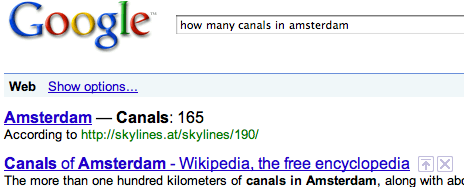
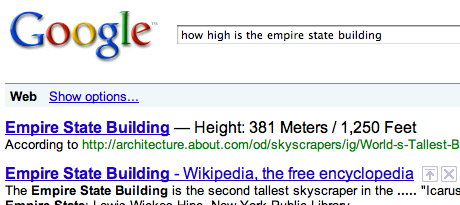
Not all “well-formed” questions evoke firm answers. And neither is it clear to me what a well-formed question requires. I proceeded with the time-honoured method of stabbing about, sometimes dignified as trial and error. I learned that there is some U.S. bias: “how high is the cn tower” failed, but “how high is the empire state building” succeeded.
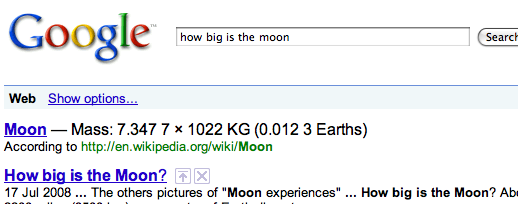
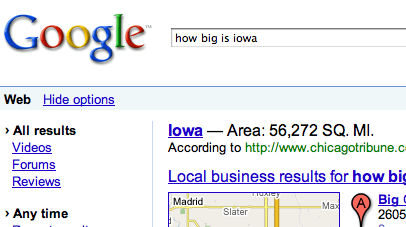
I had success with “how big is the moon” and, in a segue that made sense at the time, “how big is iowa“. But oddness happened when I asked the next natural question, “how big is alberta”:
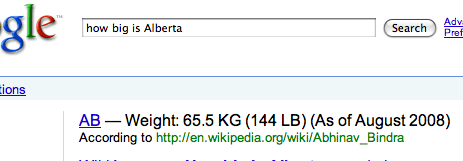
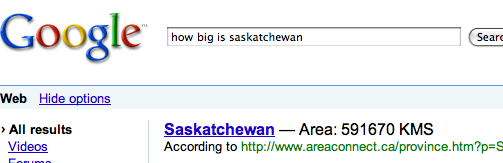
It seems that ‘alberta’ conjured up ‘AB’ which in turn evoked a Punjabi Olympic shooter. So I asked the same question about Saskatchewan, figuring that there’d be small chance of confusion here (after all, as the provincial government itself says, “Easy to draw, hard to spell”) — and found success.
I made a couple of feeble attempts to force Google to cough up something definitive in the legal realm, but Google wouldn’t play along. And so for legal workers this feature, if that’s what it is, may be little more than a curiosity. (I might suggest that if Google ever learns to recognize a legal question, it provide the same answer in every case — and they can use me as the authority — “It depends”.)
We’re told that Google is anxious about Wolfram/Alpha, and so this may be part of their attempt to become a knowledge machine as well. Whatever is the case, it’s in an ill-formed state as yet, with no clear (to me) directions on what questions framed in which way will produce answers.
Full post as published by Slaw.ca on June 21, 2009 (boomark / email).
Income Tax Changes for 2007
Get Answers to your Income Tax Questions
ASMP and Other Visual Artists File Class Action Lawsuit Against Google
Google Faces Class Action for Copyright Infringement
Google Sued for Violating the Privacy Rights of Millions of Americans
Google Sued for Violating the Privacy Rights of Millions of Americans
Google Settles Buzz Class Action for $8.5 Million
Google Settles Buzz Class Action for $8.5 Million
Google Inc.
alleging deceptive charges for ads displayed on third party web sites.
Google
Settles Book-Scanning Class Actions for $125 Million
Google
faces class action lawsuit for selling ads on parked domains

#1 Online Legal Resource

On 08-25 at 15:46PM
Acute perpendicular parking #NYPD #NYFD
On 08-18 at 22:18PM
Parallel parking gone bad. Too much gas UES NYC
On 08-18 at 21:41PM
UES NYC
On 08-18 at 21:25PM
Twitter suspends journalist critical of broadcast partner's coverage on dubious grounds @guyadams #nbcfail #twitterfail
On 07-30 at 17:57PM
Model example of 1st Amendment suppression by the People of New York City's Michael Bloomberg #OWS #NYPD
On 07-12 at 21:07PM
AG Holder lackadaisical on Operation in our Sites domain name seizures & RIAA lobbied free speech suppression @dajaz1
On 06-08 at 22:44PM
Why is the Catholic Church going to court over Obama contraception policy? @NewYorker commentary
On 05-31 at 10:08AM
Monks sue Louisiana for right to sell caskets made from forrest destroyed by Katrina
On 05-31 at 07:47AM
Are the abortion ultrasound laws headed for the Supreme Court?
On 05-15 at 21:52PM










 |
|
Contact Us | About Us | Celebrity Law Blog |
Our Partners | Disclaimer
| Law Blog Directory
| Law Jobs
| Law Tweets
| Oil Spill Video
All original material © 1999-2011 by USLaw.com. All other material, including Blog Directory feed content, are © by their respective copyright holders. |